FYSM yoga, honestly: what you'll like and what takes getting used to
Clear structure, repetition and noticeable physical work. What I value in FYSM, who might enjoy it and how to assess your first classes with realistic expectations.

If you're still wondering what FYSM actually involves, here's a proper introduction. There's still time to change your mind 🙂
I like this approach for its structure, attention to detail and the possibility of fitting practice into ordinary life. But a few things may surprise you. There will be repetition. There will be physical work. Sometimes “we've already done this” will cross your mind well before the round is over.
So here's what I value in FYSM, and what may take some getting used to.
What is FYSM, in plain language?
FYSM is a yoga methodology with prepared training sequences and progressive learning. It was developed by Igor Kovalev. The full name is Fresh Yoga Synthesized Methodology. The school's official website.
An algorithm is a prepared sequence of work. The school describes 27 algorithms at its first teacher-training level. Teachers study how they are organised and taught; participants gradually become familiar with the movements and modes of practice. About the teacher-training school.
In our club, I use that foundation for classes with different focuses and lengths: core, upper body and legs, short recordings and sessions up to an hour.
What I like about it
1. You know what you can return to
Finding a new workout every time is work in itself. Look at ten thumbnails, choose one video, start another, then discover your practice time has run out. The familiar YouTube experience, with healthy living standing in for cat videos.
A clear system makes it easier to agree on something with yourself: I have twenty minutes today, so I'll choose a short practice. With more time, I can take a longer session.
For me, regularity begins with a next step you can actually take. One heroic two-hour effort a month doesn't do much to improve your relationship with your calendar.
2. Repetition creates room to notice details
In a familiar movement, you no longer have to use all your attention working out where your foot belongs. You can notice your pelvis, how you support yourself through your hand, a habit of rushing or a tendency to choose too much range.
I enjoy practice becoming an exploration: doing something again and understanding a little more about what you're doing.
Results depend on how you practise, the level of effort you choose and what is happening in the rest of your life.
3. A session gives you different things to work on
I often explain it as a little routine maintenance for the body. That's a metaphor, of course: an hour won't inspect every system in your body and issue a warranty.
But a practice can make room for strength, mobility, balance, breathing and relaxation. A session focusing on the legs will feel different from one for the core or upper body.
Yoga here includes noticeable muscular work. If you pictured only gentle stretching to music, your first class may adjust those expectations.
4. You can practise at home and stay connected
For me, online classes remove some of the practical obstacles. A mat at home, a teacher on screen, and other people who also have work, families and plans for the evening.
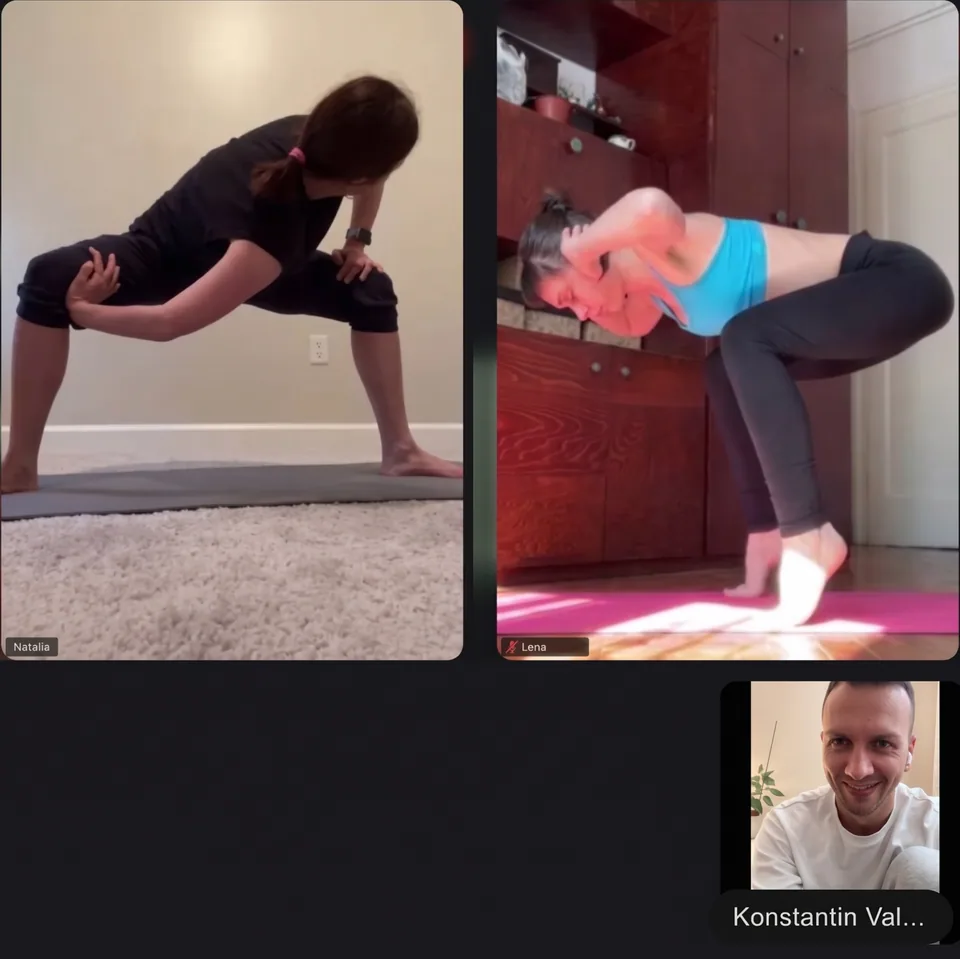
In a live Zoom class, you can receive feedback within the limits of what the camera shows. A recording lets you choose the time, pause and listen to an explanation again. The teacher cannot observe you in a recording, which matters when choosing movements and effort.
What may take some getting used to
It can be physically demanding, especially after a long break
Some early-level exercises may feel quite workout-like. Holding a position, maintaining your support and repeating a familiar movement can all be harder than they look.
Your task is to choose a manageable amount of work. You can pause, take an easier variation and ask a question. Resting during a practice doesn't erase what you've already done.
I care more about you understanding the movement and being able to keep learning than about finishing a round at any cost. Pain, dizziness or feeling noticeably worse are reasons to stop. If you have limitations, discuss suitable activity with a healthcare professional and your teacher beforehand. NCCIH's guidance.
Repetition can feel monotonous
Not everyone wants to meet the same elements again. Some people prefer a new sequence every class, and that is a reasonable preference.
What interests me in repetition is noticing changes: something is clearer, I catch myself rushing, or a movement requires less effort today. If you're consistently bored, though, discuss it with your teacher and explore another format. You have no obligation to fall in love with FYSM.
Joining a club doesn't automatically produce a result
Registration alone doesn't build a practice habit. Even a carefully designed programme won't choose your mat time for you.
I would assess the first classes in straightforward terms: can you make time, follow the explanation, manage the effort and imagine returning? Changes in strength, mobility and endurance are assessed over a longer period, taking your starting point into account.
What might your first class look like?
Broadly, we settle our attention, prepare for the main work, move through a sequence and leave time for recovery and relaxation.
Within that structure, the details matter: support, body position, transitions, breathing and intensity. You don't need to understand the whole methodology on day one. Begin by getting to know the explanations and saying when something isn't clear.
Progress can begin with an easier variation. Recognising that it's time to reduce the effort is a useful skill in its own right.
If you mainly want a calm practice, ask about the class content. Our Russian-speaking club has a gentler Friday format 🪷. That still doesn't replace individual consideration of your limitations.
Who might enjoy FYSM?
You might try it if you are interested in:
- a clear structure and returning to familiar movements;
- combining strength work with mobility;
- attention to the details of how you move;
- practising at home with a choice of session lengths;
- staying connected with a teacher and group.
If you currently want free improvisation, partner acrobatics or only an extended relaxation practice, you can look for a class built around that. My article “Types of yoga: how they differ and how to choose yours” offers some starting points.
For a comparison of FYSM with Hatha, Ashtanga and Critical Alignment Yoga, start here.
How to try it with realistic expectations
A trial week is a chance to get to know the format, the explanations and the club. Choose an accessible practice, leave room for rest and see whether you can make some time for yourself.
You don't have to make it look impressive straight away. Understanding what you're doing and wanting to return are useful places to begin.
Start your free week at YogaCraft →
Verify your email, complete the required intake about your goals and limitations, then start your 7 days when you're ready. No card is needed, and the trial doesn't automatically create a subscription.