Meditation basics, or learning to do nothing and get something out of it
Why a YouTube break can leave you more tired, how to notice your “meditation daisy” and where to begin with attention practice. A personal story from a life in tech.
First published in Russian on Habr, in EPAM's blog, on 17 June 2020. By Konstantin Valuiskii (@sveekey).
“Here we go again,” my wife said when I was working late. Again. “It's an interesting project; I need to finish it.” “I'll push a bit harder now, then things will get easier.” My standard collection of responses to overwork.
Working remotely made it even easier to overload myself. No commute, nobody inviting me for a coffee, and fewer ways to take a break outside.
Online, everyone talks about working efficiently and balancing work with rest. But it's so much easier to put on YouTube and eat something sweet. An hour later, you're even more tired: “What the hell? I came here to watch something useful. Why am I watching an SUV wrap itself around a lamppost?!”
When I wrote the first version of this article in 2020, I was a game designer at EPAM and often worked too much: several projects at once, a side project at home, and this article. Sometimes there were so many tasks that listing them took longer than doing them. YouTube and sugar weren't enough to keep me cheerful any more. I needed something stronger.
In this article, I'll explain how meditation helps me deal with stress and overload, and where you can begin exploring it.
Where stress comes from
One familiar source of stress for me is the feeling that I should constantly be doing something or rushing somewhere.
Even a simple break can make me feel guilty about supposedly doing nothing while a pile of tasks waits to be dealt with.
Suggesting that I just sit and observe, without planning the next task, feels like a crime against time itself.
I didn't have this problem as a child. I could sit on a bench for hours, absorbed in watching the grass grow. It was interesting. I was happy with how much was happening around me, with no idea that this was rather like meditation.
As we get older, though, it can seem that the more we think and work, the smarter, richer and more famous we'll become. Along come multitasking, a shortage of time and the urge to squeeze more tasks into every minute.
Does that feel pleasant? Hardly. So we start looking for a solution, creating demand for a “meditation experience”.
There is an entire meditation industry ready to teach us to quieten stress or fall asleep on time to nature sounds and bedtime stories. A lot of money goes into it — this report, in Russian, is from 2020.
But wouldn't the ability to pause be useful in ordinary life, too?
Learning to meditate is easier than it seems
Let's try meditating right now.
Get comfortable. Hold your palm in front of you and choose a small point on it. Try gently keeping your attention there for about a minute. You can blink; there's no need to strain your eyes. If this feels uncomfortable, you can observe your natural breathing without deliberately changing it instead.
If you became absorbed in it, congratulations: you managed to stay with one object of attention for a little while.
If you got distracted and started thinking about your evening plans, even better. You've noticed how attention shifts by itself. That's material for the practice.
The most common answer
You probably didn't even try, because there's no time :).
Keep returning your attention to your palm whenever you notice you've drifted away.
If we drew a diagram of attention, it might look like a meditation daisy. The object of meditation — your palm — sits in the centre. The petals represent how far and for how long your attention wanders. In this picture, the petals can become smaller with practice: you remember the object sooner and spend less time distracted.
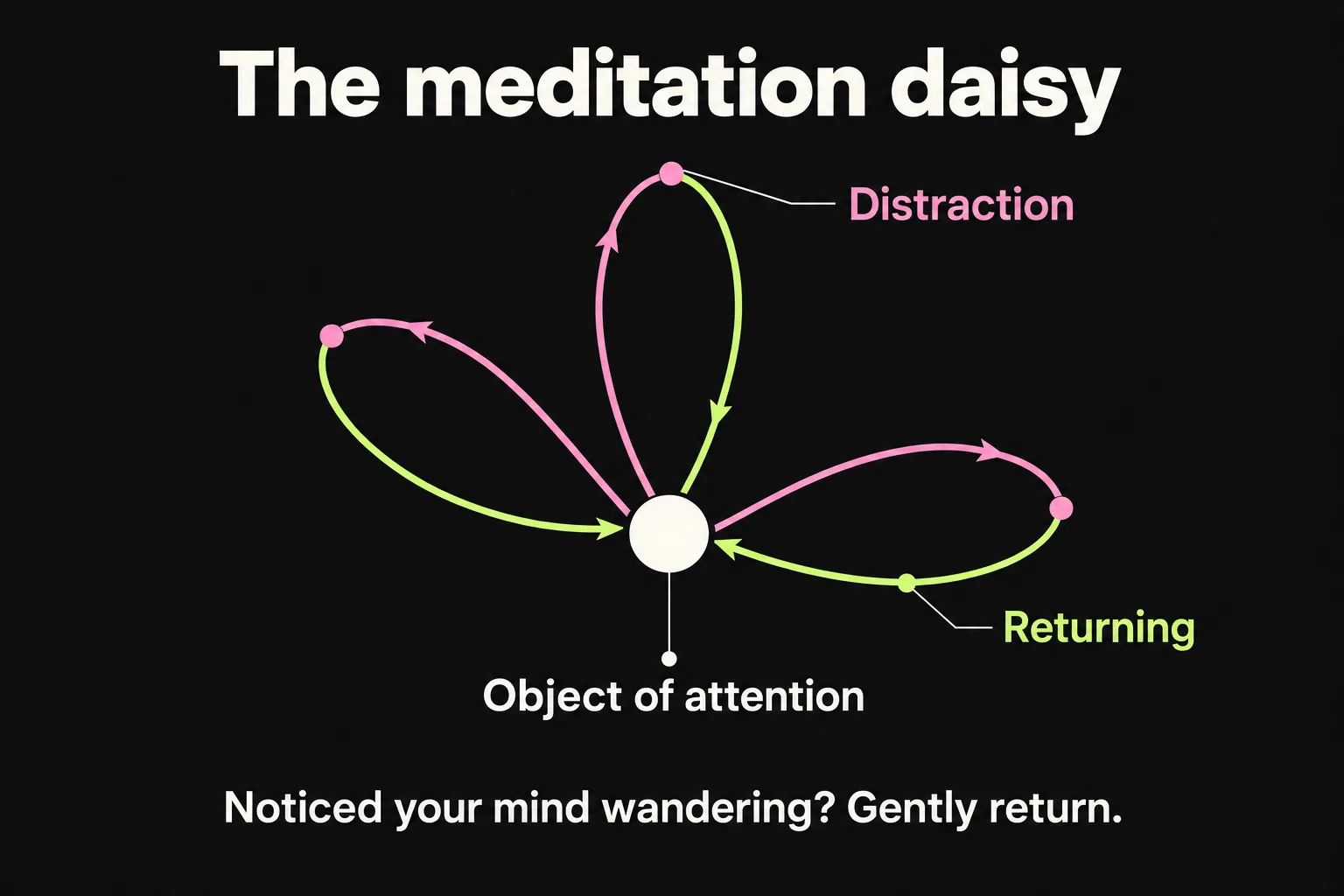
It reminds me of that ease I felt as a child, when I could simply watch what was happening. You don't have to achieve a complete absence of thoughts. Noticing the distraction and returning is enough.
This doesn't mean your tasks will evaporate. They're simply more pleasant to do from a calmer state.
And the more things become pleasant, the more pleasant life feels overall.
If a thought won't leave you alone, it can help to pause, shift your attention and return to the problem with a clearer head.
Why you might feel calmer afterwards
I find a technical analogy useful for explaining repetitive thinking. The mind doesn't just consume thoughts, the way the tongue consumes sugar; it also produces them, creating something like recursion. Think about a problem, get upset, think about it even more.
Returning attention to a simple object gives me a chance to notice that loop and step out of it for a moment. This describes my experience, rather than promising the same effect for everyone.
In the first version of this article, I linked this to vigilance decrement: a decline in attention during a monotonous task. Today, I'd keep that comparison as an analogy. It doesn't, on its own, demonstrate how meditation works.
Research into meditation and mindfulness offers encouraging but mixed findings for stress and anxiety. It doesn't justify promising to “reset” someone's stress to zero. NCCIH's overview also notes limitations in the research and the possibility of unpleasant reactions to practice.
Can we respond to stress differently?
Even if meditation leaves you calmer, will you meditate every time something doesn't go to plan? Neither will I.
That's why I'm interested in more than resting during a session. I'm also interested in noticing my reactions in everyday life. Sometimes a small “window” opens between a trigger and my habitual response.
Say someone is rude to you. With practice, you may be more likely to notice a moment of choice: be rude back, or wish them a long and healthy life.
The point isn't which response you choose. The point is that there is a choice. Otherwise, every little trigger can set you off like a match.
Either you choose, or your boss or the person at the checkout will choose for you.
This ability to notice is called mindfulness, and meditation is one way to practise it. During meditation, you notice that you've wandered and return to your object. In life, too, noticing that you're about to head in the wrong direction is half the work. Then you have a chance to choose what to do next.
Observe whether you can notice and deliberately redirect your thoughts when something goes wrong. If you often regret things done in the heat of the moment, developing this awareness through meditation may be worth exploring.
Different ways to meditate
Few people can stop getting distracted at the snap of their fingers. Simple supports can help at first: counting out-breaths, noticing sensations in the body or looking at your palm. I think of these as little “crutches” that help us get to know how attention works.
With time, finding that familiar focus may become easier.
Different traditions describe stages and states differently. Here are a few ways of practising that I'm familiar with.
Meditation practices can have different aims and objects of attention.
If you want to recharge and develop mindfulness, you might begin with simple objects that don't require effort to keep going, such as breathing.
A traditional practice using the breath as its object is called Anapanasati. According to Buddhist tradition, it was used by Siddhartha Gautama Shakyamuni before he became the Buddha. It is a Buddhist meditation practice with a defined sequence of stages and instructions.
Breathing is a convenient object because it happens automatically. Yet beginners can find it difficult to notice its subtleties in different parts of the body without influencing its natural course.
Anapanasati describes 16 steps. You don't have to work through the entire sequence to begin observing the breath. You can start with a simple practice and clear guidance.
My teacher briefly explains Anapanasati here (in Russian).
If you're drawn to sound and rhythm, you could explore mantras: particular sequences of sounds. Meditation through their repetition is called japa.
With AUM, for example, you can observe the sound, rhythm and sensations that arise. I enjoy getting to know the original sounds: translation can change how both the meaning and the sound are experienced.
In japa meditation, the mantra, its sound and its meaning become the object of attention. Repetition helps bring attention back. For me, both the sound and the meaning someone gives it matter.
Compare a musical rendition of a mantra with rhythmic chanting of the same mantra by someone trained to do it. Music has its aesthetic appeal. I think of a mantra as a “can opener” for the mind — a traditional explanation of the Sanskrit word connects man with mind and tra with a tool.
If you're curious about habitual beliefs, you may come across practices involving visualisation. For example, you could observe the images that appear alongside thoughts such as “I can't do this” or “I'm too old for that”.
For me, this can help reveal a familiar script and make room to imagine another way of acting. It's an exercise in exploring experience, rather than a guarantee that whatever you imagine will happen.
If you need to solve a difficult logical problem, you can take a pause and then calmly observe the possible solutions that emerge. This may appeal to people whose work involves logical or creative thinking: programmers, designers, architects and others.
A few things to know before you begin
-
One of meditation's biggest obstacles is guilt about time spent “doing nothing”. Set aside time in advance. Decide that you're allowed to spend it pausing and paying attention to yourself. Those “important” thoughts about work and rest can wait.
-
Focusing on one object can seem incredibly difficult: looking at a point for a while or feeling the breath at the tip of your nose. That is part of the process. Simply return your attention to the object.
-
Don't try too hard to “achieve” meditation, or expect special sensations or effects. The more you wait for something, the harder it can be to experience it. Expectation is another thought sneaking in through the back door.
-
I found guided meditation easier to begin with: a voice explains what to do as you go.
-
For me, five minutes a day is an easier habit to maintain than trying to find a spare hour every time.
-
I'd rather start with one clear practice than seven different meditations for every occasion.
-
Start small. Three to five minutes a day is enough to begin exploring.
-
You don't need to reach a special state. If you keep falling asleep, perhaps what you need most right now is rest.
-
Emotions during practice can vary. If you feel noticeably worse or more anxious, you don't have to force yourself to continue.
-
Meditation does not replace professional care for clinical depression or other health conditions. Discuss any role it might play in treatment with a qualified professional.
What about the esoteric side?
Ask someone whether they meditate and the conversation can become awkward. Will people think I'm in a cult, performing rituals with candles and incense to “raise my vibration”? Many meditation apps try to distance themselves from anything remotely esoteric — sometimes stripping the practice a little too bare.
Descriptions of “levitation”, “auras” and “special effects” can sound impressive. I treat them as imagery and subjective experiences, rather than evidence of supernatural abilities.
There's no need to chase unusual sensations. If your body becomes stiff, change position. If your eyes get tired, let them rest. Getting to know the practice isn't about enduring discomfort at any cost.
Unfortunately, cutting out ALL esoteric elements can also mean discarding Sanskrit mantras and mandalas, replacing them with translated words and an uninteresting dot to stare at. Something of the practice's meaning and charm can be lost along the way.
Sometimes esoteric language protects a deeper meaning; sometimes it advertises superpowers. Some practices have none of it, while others are steeped in it. What is clear is that a great deal of time and effort has gone into developing tools for meditation. I prefer a calm, thoughtful approach: use what works for you.
If a tool works for you, use it, regardless of what other people think of it.
What I take from all this
-
I think of meditation as a lubricant: stress has a harder time sticking to you. The more flexible and less rigid a person is, the fewer situations seem to catch them. When everything must be a certain way, even small parts of life can become enormous problems.
-
Simple “doing nothing” turns out to contain a surprising amount of activity in the mind. A clear point of focus helps us notice it and gradually get to know our attention.
-
Meditation is one tool for working with attention and wellbeing. I find it useful, but the right format and people's responses to it vary.
Things in life constantly fail to go to plan. That doesn't mean we have to worry about every one of them. I'd like you to spend your time on what matters to you, rather than your nerves on life's small annoyances. Meditation can be a useful tool for that.
The story behind MindCraft
Counting breaths is a common way to settle into meditation: count to ten, then begin again. If the counting becomes automatic, you might discover you've reached eighteen.
I used this principle in my app, “MindCraft: The Art of Meditation”. The idea itself came to me while I was “doing nothing”.
In the version I described in 2020, you tapped a button on the right with each out-breath. When you reached ten, you switched to the button on the left. You continued until a “lotus of mindfulness” grew.
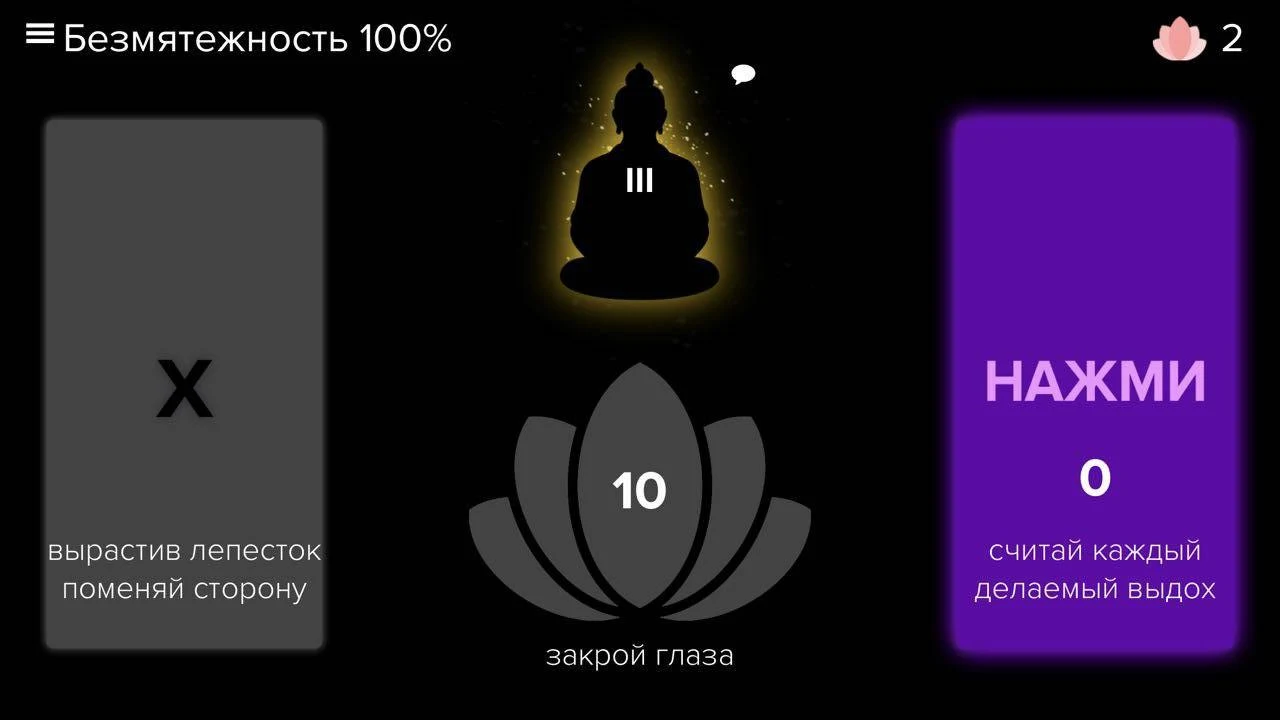
The project video makes it clearer.
As soon as you start thinking about renovating the hallway, you forget to switch sides, and the app reminds you. Eight five-minute lessons without losing count once? I couldn't do it, but I won't rule out the possibility.
The app is a story about an idea becoming a tool. You don't need to install it to try simply observing your attention.
Practising together
Meditation is also part of Hatha yoga. In our FYSM online club, we make time for it during Savasana: letting go of muscular effort and observing the breath, sensations in the body and where attention goes. You can begin exploring meditation right within a yoga class.
I'm now thinking about a separate meditation club: regular practice, clear explanations and a chance to ask questions when something is difficult.
The club hasn't opened yet. If this interests you, leave your details below and tell me what you'd hope to get from it. That will help me understand the interest and shape a useful format.
I'd like you to have both the attention and the energy for what truly matters to you. Sometimes that can begin with a few minutes in which, at last, you don't have to get anything done.